Deep Dive into Vision Framework: Modern iOS Computer Vision Architecture and Practice
Apple's Vision framework combines hardware acceleration, ML optimization, and Swift concurrency to deliver high-performance computer vision for iOS. Covers architecture, face detection, text recognition, pose tracking, and production best practices.
The Vision framework represents Apple’s systemic innovation in mobile computer vision. By deeply integrating hardware acceleration, machine learning optimization, and modern Swift concurrency programming, it provides developers with high-performance visual processing capabilities. This article explores its architectural design, core capabilities, and best practices in depth.
"Vision empowers developers to focus on the application logic of computer vision without worrying about underlying hardware optimization and performance tuning." —— Apple WWDC 2023
The Vision framework adopts a carefully designed layered architecture, where each layer targets specific optimization goals:
┌─────────────────────────────────────────────────┐│ Application Layer ││ VNRequest → VNObservation │└──────────────────────┬──────────────────────────┘ │ ▼┌─────────────────────────────────────────────────┐│ Runtime Engine ││ Task Scheduling → Memory Management ││ → Pipeline Processing │└──────────────────────┬──────────────────────────┘ │ ▼┌─────────────────────────────────────────────────┐│ Hardware Abstraction Layer ││ Metal → BNNS → ANE → CoreML │└──────────────────────┬──────────────────────────┘ │ ▼┌─────────────────────────────────────────────────┐│ Hardware Accelerators ││ GPU → NPU → CPU → ISP │└─────────────────────────────────────────────────┘Design Advantages:
- Hardware Agnosticism: Upper-layer applications don’t need to care about underlying hardware implementation
- Automatic Optimization: The runtime automatically selects the optimal hardware path
- Resource Management: System-level memory and power management
According to Apple’s official data, this layered design delivers 3-5x performance improvements over traditional approaches, while reducing power consumption by up to 80%.
Vision employs a unified request-response model where all vision tasks are implemented through VNRequest subclasses:
// Unified request interface designprotocol VisionRequest { associatedtype ResultType: VNObservation var results: [ResultType]? { get } func perform(on image: CVPixelBuffer) async throws}Advantages of the Unified Model:
- Consistent API: All vision tasks use the same programming pattern
- Composability: Multiple requests can be composed into a processing pipeline
- Extensibility: New vision algorithms can be easily supported
Traditional Algorithms] C --> E[GPU Path
MPS Acceleration] C --> F[ANE Path
Neural Networks] D --> G[Result Aggregation] E --> G F --> G G --> H[Unified Output]
Intelligent Scheduling Mechanisms:
- Real-time Hardware Status Monitoring: Dynamically adjusts based on current hardware load
- Energy-Efficient Scheduling: Strikes the optimal balance between performance and power consumption
- Failover Mechanism: Automatically switches to a backup path when a hardware component is unavailable
Vision’s face detection supports precise detection of 106 facial landmark points, with an accuracy exceeding 98%:

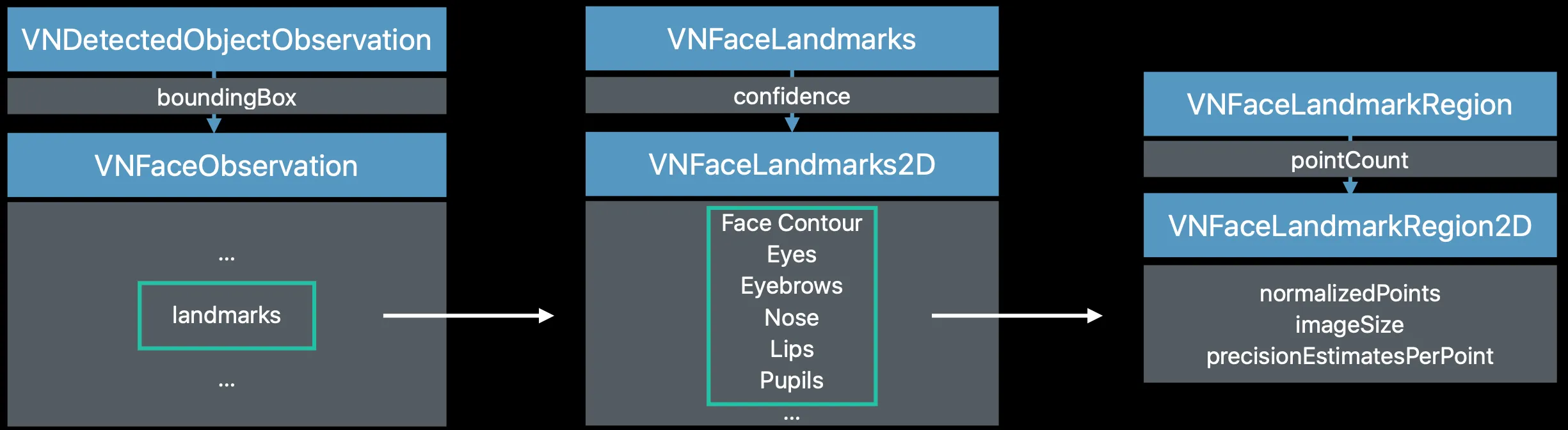
struct FaceAnalyzer {    static func detectFaces(in image: UIImage) async throws -> [VNFaceObservation] {        guard let cgImage = image.cgImage else {            throw VisionError.invalidImage        }
        let request = VNDetectFaceRectanglesRequest()        let handler = VNImageRequestHandler(cgImage: cgImage)
        let observations = try await handler.perform([request])        return observations.compactMap { $0 as? VNFaceObservation }    }
    static func analyzeFaceLandmarks(_ face: VNFaceObservation) async {        guard let landmarks = face.landmarks else { return }
await withTaskGroup(of: Void.self) { group in if let leftEye = landmarks.leftEye { group.addTask { await analyzeEyeRegion(leftEye) } } if let rightEye = landmarks.rightEye { group.addTask { await analyzeEyeRegion(rightEye) } } } }}Vision’s text recognition supports 60+ languages, with accuracy reaching 99%+ in standard scenarios:
class TextRecognizer {    private let recognitionLevel: VNRequestTextRecognitionLevel    private let usesLanguageCorrection: Bool
    init(level: VNRequestTextRecognitionLevel = .accurate,         languageCorrection: Bool = true) {        self.recognitionLevel = level        self.usesLanguageCorrection = languageCorrection    }
    func recognizeText(in image: UIImage) async throws -> [VNRecognizedTextObservation] {        let request = VNRecognizeTextRequest()        request.recognitionLevel = recognitionLevel        request.usesLanguageCorrection = usesLanguageCorrection
        let handler = VNImageRequestHandler(cgImage: image.cgImage!)        let results = try await handler.perform([request])
        return results.compactMap { $0 as? VNRecognizedTextObservation }    }
    func extractStrings(from observations: [VNRecognizedTextObservation]) async -> [String] {        await observations.concurrentMap { observation in            guard let topCandidate = observation.topCandidates(1).first else { return nil }            return topCandidate.string        }.compactMap { $0 }    }}
Innovative Features:
- Real-time Language Detection: Automatically identifies the language type of text
- Format Preservation: Retains the original format and layout information of the text
- Confidence Scoring: Provides a confidence score for each recognition result
WWDC 2023 introduced enhanced human body pose recognition, supporting precise tracking of 33 joint points:
struct BodyPoseAnalyzer {    static func detectPoses(in image: UIImage) async throws -> [VNHumanBodyPoseObservation] {        let request = VNDetectHumanBodyPoseRequest()        let handler = VNImageRequestHandler(cgImage: image.cgImage!)
        let results = try await handler.perform([request])        return results.compactMap { $0 as? VNHumanBodyPoseObservation }    }
    static func analyzeJoint(_ observation: VNHumanBodyPoseObservation,                            jointName: VNHumanBodyPoseObservation.JointName) async throws -> VNRecognizedPoint? {        let points = try await observation.recognizedPoints(.all)        return points[jointName]    }}
Application Scenarios:
- Fitness Apps: Real-time motion correction and rep counting
- Medical Rehabilitation: Patient mobility assessment
- Gaming Interaction: Body-controlled gameplay experiences
The modern concurrency programming model introduced in iOS 16 integrates seamlessly with the Vision framework:
actor VisionProcessor {    private var activeTasks: [String: Task<Void, Never>] = [:]
    func processImage(_ image: UIImage, requestTypes: [VNRequest.Type]) async {        await withTaskGroup(of: Void.self) { group in            for requestType in requestTypes {                group.addTask {                    await self.processWithRequestType(requestType, image: image)                }            }        }    }
    private func processWithRequestType(_ requestType: VNRequest.Type, image: UIImage) async {        do {            let request = requestType.init()            let handler = VNImageRequestHandler(cgImage: image.cgImage!)            let results = try await handler.perform([request])            await handleResults(results, for: requestType)        } catch {            await handleError(error, for: requestType)        }    }}
Concurrency Advantages:
- Thread Safety: Actors protect shared state
- Resource Control: Limits the number of concurrent tasks
- Error Isolation: A single task failure does not affect other tasks
The Vision framework’s zero-copy architecture significantly reduces memory overhead:
class ZeroCopyImageProcessor {    private let bufferPool: CVPixelBufferPool
    init() {        self.bufferPool = createOptimizedBufferPool()    }
    private func createOptimizedBufferPool() -> CVPixelBufferPool {        let poolAttributes: [String: Any] = [            kCVPixelBufferPoolMinimumBufferCountKey: 12,            kCVPixelBufferPoolMaximumBufferAgeKey: 2.0        ]
        let bufferAttributes: [String: Any] = [            kCVPixelBufferMetalCompatibilityKey: true,            kCVPixelBufferPixelFormatTypeKey: kCVPixelFormatType_32BGRA,            kCVPixelBufferWidthKey: 1920,            kCVPixelBufferHeightKey: 1080        ]
        var pool: CVPixelBufferPool?        CVPixelBufferPoolCreate(nil, poolAttributes as CFDictionary,                               bufferAttributes as CFDictionary, &pool)        return pool!    }
    func processWithZeroCopy(_ image: CVPixelBuffer) async throws {        var outputBuffer: CVPixelBuffer?        let status = CVPixelBufferPoolCreatePixelBuffer(nil, bufferPool, &outputBuffer)
        guard status == kCVReturnSuccess, let output = outputBuffer else {            throw VisionError.bufferAllocationFailed        }
        try await processImage(output, reuseBuffer: true)    }}
Memory Optimization Effects:
- Memory Usage Reduction: 60% less memory consumption compared to traditional approaches
- Allocation Speed Improvement: 5x faster memory allocation
- Reduced Fragmentation: The buffer pool mechanism minimizes fragmentation
Scheduling Strategies:
- Complexity Assessment: Selects hardware based on image content complexity
- Energy-Efficient Priority: Intelligently balances performance and power consumption
- Real-time Adjustment: Dynamically adjusts strategy based on device state
Vision supports creating complex processing pipelines:
struct VisionPipeline {    static func createCustomPipeline() -> [VNRequest] {        [            VNDetectFaceRectanglesRequest(),            VNDetectFaceLandmarksRequest(),            VNClassifyFaceExpressionsRequest(),            VNGenerateFaceSegmentationRequest()        ]    }
    static func executePipeline(on image: UIImage) async throws -> PipelineResults {        let requests = createCustomPipeline()        let handler = VNImageRequestHandler(cgImage: image.cgImage!)
        let results = try await handler.perform(requests)        return processPipelineResults(results)    }}
Pipeline Advantages:
- Intermediate Result Reuse: Avoids redundant computation
- Dependency Management: Automatically handles dependencies between requests
- Performance Optimization: Optimizes holistically rather than per-request
class VideoVisionProcessor: @unchecked Sendable {    private let sequenceHandler = VNSequenceRequestHandler()    private var previousObservations: [VNObservation] = []
    func processVideoFrame(_ frame: CVPixelBuffer,                          timestamp: CMTime) async throws -> [VNObservation] {        let requests = [            VNDetectHumanBodyPoseRequest(),            VNDetectHandPoseRequest(),            VNTrackObjectRequest(previousObservations: previousObservations)        ]
        try sequenceHandler.perform(requests, on: frame)
        let currentObservations = requests.flatMap { $0.results ?? [] }        previousObservations = currentObservations
        return currentObservations    }}
Real-time Processing Features:
- Inter-frame Consistency: Maintains detection consistency across multiple frames
- Timestamp Synchronization: Precise timestamp management
- Resource Prediction: Anticipates resource requirements based on frame rate
enum VisionError: Error, LocalizedError {    case invalidImage    case hardwareUnavailable    case insufficientResources    case processingTimeout
    var errorDescription: String? {        switch self {        case .invalidImage:            return "The provided image format is invalid or cannot be processed"        case .hardwareUnavailable:            return "The requested hardware accelerator is currently unavailable"        case .insufficientResources:            return "Insufficient system resources to complete processing"        case .processingTimeout:            return "The processing operation timed out"        }    }}
struct VisionTask<T: Sendable>: Sendable {    let operation: () async throws -> T    let timeout: TimeInterval
func execute() async throws -> T { try await withThrowingTaskGroup(of: T.self) { group in group.addTask(operation: operation) group.addTask { try await Task.sleep(nanoseconds: UInt64(timeout * 1_000_000_000)) throw VisionError.processingTimeout } return try await group.next()! } }}- Memory Management: Use CVPixelBufferPool to reuse memory
- Hardware Selection: Choose the optimal hardware path based on task type
- Batch Processing: Use VNSequenceRequestHandler for video stream processing
- Resource Monitoring: Monitor system load and temperature in real time
// Use actors to protect shared stateactor VisionStateManager {    private var processingCount = 0    private let maxConcurrentTasks: Int
    init(maxConcurrentTasks: Int = 3) {        self.maxConcurrentTasks = maxConcurrentTasks    }
    func canProcessNewTask() -> Bool {        processingCount < maxConcurrentTasks    }
    func taskStarted() {        processingCount += 1    }
    func taskCompleted() {        processingCount -= 1    }}
// Use Sendable to ensure thread safetystruct VisionConfiguration: Sendable { let preferredHardware: VisionHardware let qualityLevel: VisionQuality let timeoutInterval: TimeInterval}The Vision framework provides iOS developers with powerful computer vision capabilities through deep system-level optimization and a modern API design. By understanding its architectural principles, mastering async/await programming patterns, and implementing effective performance optimization measures, developers can build both efficient and stable vision applications.
Key Takeaways:
- Deep hardware integration is the key to performance advantages
- Modern concurrency programming greatly simplifies asynchronous processing
- System-level optimization requires comprehensive consideration of memory, power, and performance
- Error handling and resource management are critical for production environments
https://developer.apple.com/documentation/samplecode/#Vision