一道算法综合题:Path With Minimum Effort
LeetCode 1631. Path With Minimum Effort
You are a hiker preparing for an upcoming hike. You are given heights, a 2D array of size rows x columns, where heights[row][col] represents the height of cell (row, col). You are situated in the top-left cell, (0, 0), and you hope to travel to the bottom-right cell, (rows-1, columns-1) (i.e., 0-indexed). You can move up, down, left, or right, and you wish to find a route that requires the minimum effort.
A route’s effort is the maximum absolute difference in heights between two consecutive cells of the route.
Return the minimum effort required to travel from the top-left cell to the bottom-right cell.
- Example 1:
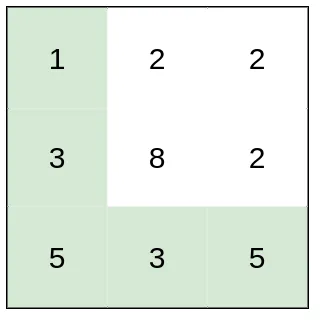
Input: heights = [[1,2,2],[3,8,2],[5,3,5]]Output: 2Explanation: The route of [1,3,5,3,5] has a maximum absolute difference of 2 in consecutive cells.This is better than the route of [1,2,2,2,5], where the maximum absolute difference is 3.这道题之所以是一道优秀的综合题,在于它可以用至少四种不同的算法范式来解决,且每种解法都体现了不同的思维角度:
| 方法 | 核心思想 | 时间复杂度 |
|---|---|---|
| 二分 + BFS/DFS | 将最优化问题转化为判定问题 | O(mn · log(maxHeight)) |
| 并查集 (Kruskal) | 将问题建模为最小瓶颈路 | O(mn · log(mn)) |
| Dijkstra | 改造最短路算法,松弛条件变为 max | O(mn · log(mn)) |
关键观察:这道题求的不是路径上所有边权之和的最小值(经典最短路),而是路径上单条边权的最大值的最小值。这种 “minimax path” 问题在图论中称为最小瓶颈路 (Minimum Bottleneck Path)。
将最优化问题转化为判定问题:
- 判定问题:给定一个阈值
threshold,是否存在一条从左上角到右下角的路径,使得路径上相邻格子的高度差都不超过threshold? - 单调性:如果
threshold = k时可行,那么threshold = k+1时一定也可行。这个单调性保证了二分搜索的正确性。 - 搜索空间:答案在
[0, maxHeight - minHeight]之间,对这个区间做二分,每次用 BFS/DFS 验证可行性。
class Solution {private:    int m, n;    int dir[4][2] = { {0, 1}, {0, -1}, {1, 0}, {-1, 0} };
public:    int minimumEffortPath(vector<vector<int>>& heights) {        m = heights.size();        n = m > 0 ? heights[0].size() : 0;        int left = 0, right = 10e6;        int res = -1;        while (left <= right) {            int mid = left + (right - left) / 2;            bool reachable = bfs(heights, mid);            if (reachable) {                res = mid;                right = mid - 1;            }else {                left = mid + 1;            }        }        return left;    }
bool bfs(vector<vector<int>> &heights, int limit) { queue<pair<int, int>> q; q.push({0, 0}); vector<vector<bool>> vis(m, vector<bool>(n, false)); vis[0][0] = true; while (!q.empty()) { int x = q.front().first, y = q.front().second; q.pop(); if (x == m - 1 && y == n - 1) { return true; } for (int i = 0; i < 4; i++) { int new_x = x + dir[i][0]; int new_y = y + dir[i][1]; if (new_x >= 0 && new_y >= 0 && new_x < m && new_y < n && !vis[new_x][new_y] && abs(heights[new_x][new_y] - heights[x][y]) <= limit) { q.push({new_x, new_y}); vis[new_x][new_y] = true; } } } return false; }}class Solution {private: int m, n; int dir[4][2] = { {0, 1}, {0, -1}, {1, 0}, {-1, 0} };
public: int minimumEffortPath(vector<vector<int>>& heights) { m = heights.size(); n = m > 0 ? heights[0].size() : 0; vector<vector<bool>> vis(m, vector<bool>(n, false)); int left = 0, right = 10e6; while (left < right) { int mid = left + (right - left) / 2; for (int i = 0; i < m; i++) { std::fill(vis[i].begin(), vis[i].end(), false); } dfs(heights, 0, 0, mid, vis); if (vis[m - 1][n - 1]) { right = mid; }else { left = mid + 1; } } return left; }
void dfs(vector<vector<int>> &heights, int x, int y, int threshold, vector<vector<bool>> &vis) { if (x < 0 || y < 0 || x >= m || y >= n || vis[x][y]) { return; } vis[x][y] = true; for (int i = 0; i < 4; i++) { int new_x = x + dir[i][0]; int new_y = y + dir[i][1]; if (new_x < 0 || new_y < 0 || new_x >= m || new_y >= n || vis[new_x][new_y]) { continue; } if (abs(heights[new_x][new_y] - heights[x][y]) > threshold) { continue; } dfs(heights, new_x, new_y, threshold, vis); } }};换一个角度:把网格看成图,每对相邻格子之间有一条边,边权为高度差的绝对值。
问题转化为:在这张图上找一条从 (0,0) 到 (m-1,n-1) 的路径,使路径上最大边权最小。
Kruskal 的思想:将所有边按权值从小到大排序,依次加入并查集。当起点和终点第一次连通时,最后加入的那条边的权值就是答案。
为什么正确?因为我们只加入了权值 ≤ 当前边的所有边,此时起点终点恰好连通,说明存在一条路径其最大边权恰好等于当前边权,且不可能更小(否则早就连通了)。
class UnionFind {private:    vector<int> pa;    int count;public:    UnionFind(int n):pa(n), count(n) {        for (int i = 0; i < n; i++) {            pa[i] = i;        }    }    int root(int x) {        return x == pa[x] ? x : pa[x] = root(pa[x]);    }    void uni(int x, int y) {        int px = root(x);        int py = root(y);        if (px != py) {            pa[px] = py;            count--;        }    }    bool connected(int x, int y) {        return root(x) == root(y);    }};
struct Edge {    int x, y;    int d;    Edge(int _x, int _y, int _d): x(_x), y(_y), d(_d) {};    bool operator < (const Edge &other) const {        return d > other.d;    }};
class Solution {public: int minimumEffortPath(vector<vector<int>>& heights) { int m = heights.size(); int n = heights[0].size(); priority_queue<Edge> edges; for (int i = 0; i < m; i++) { for (int j = 0; j < n; j++) { int id = i * n + j; if (i > 0) { edges.push(Edge(id - n, id, abs(heights[i][j] - heights[i - 1][j]))); } if (j > 0) { edges.push(Edge(id - 1, id, abs(heights[i][j] - heights[i][j - 1]))); } } } UnionFind uf(m * n); int res = 0; while (!edges.empty()) { Edge e = edges.top(); edges.pop(); uf.uni(e.x, e.y); if (uf.connected(0, m * n - 1)) { res = e.d; break; } } return res; }};经典 Dijkstra 求的是路径边权之和最小值,松弛条件是:
dist[v] = min(dist[v], dist[u] + w(u,v))本题只需修改松弛条件为:
dist[v] = min(dist[v], max(dist[u], w(u,v)))即到达 v 的”距离”定义为路径上的最大边权。这个变形仍满足 Dijkstra 的贪心性质:优先队列弹出的节点,其 dist 值一定是最优的,因为后续弹出的节点只可能经过更大的边。
struct Node {    int x, y;    int limit;    Node(int _x, int _y, int _limit) : x(_x), y(_y), limit(_limit) {}    bool operator < (const Node &other) const {        return limit > other.limit;    }};
class Solution {private:    int dirs[4][2] = { {0, 1}, {0, -1}, {1, 0}, {-1, 0} };
public:    int minimumEffortPath(vector<vector<int>>& heights) {        int m = heights.size(), n = m > 0 ? heights[0].size() : 0;        vector<vector<bool>> vis(m, vector<bool>(n, false));        priority_queue<Node> pq;        pq.emplace(Node(0, 0, 0));        vector<int> dist(m * n, INT_MAX);        dist[0] = 0;        while (!pq.empty()) {            Node node = pq.top();            pq.pop();            int x = node.x, y = node.y, limit = node.limit;            if (vis[x][y]) {                continue;            }            if (x == m - 1 && y == n - 1) {                break;            }            vis[x][y] = true;            for (int i = 0; i < 4; i++) {                int nx = x + dirs[i][0];                int ny = y + dirs[i][1];                if (nx < 0 || ny < 0 || nx >= m || ny >= n) {                    continue;                }                int new_limit = max(limit, abs(heights[nx][ny] - heights[x][y]));                if (new_limit >= dist[nx * n + ny]) {                    continue;                }                dist[nx * n + ny] = new_limit;                pq.emplace(Node(nx, ny, new_limit));
} } return dist.back(); }};三种方法本质上在回答同一个问题,但视角不同:
- 二分 + BFS/DFS:猜答案,验证可行性。适用于答案具有单调性的场景。
- 并查集:从小到大加边,观察何时连通。适用于瓶颈路问题。
- Dijkstra:贪心扩展,每次走当前代价最小的路。适用于改造后仍满足贪心性质的最短路变体。
这类”最小化路径上最大边权”的问题在 LeetCode 和竞赛中反复出现:
| 题目 | 核心差异 |
|---|---|
| 778. Swim in Rising Water | 边权变为 max(grid[nx][ny], grid[x][y]),即需等待水位降到格子高度才能通过 |
| 1102. Path With Maximum Minimum Value | 反过来:最大化路径上的最小值 (maximin),同样可用三种方法 |
| 2812. Find the Safest Path in a Grid | 先 BFS 预处理每个格子到最近威胁的距离,再求 maximin path |
| 1514. Path with Maximum Probability | 边权为概率,路径值为乘积的最大值,Dijkstra 取 max 变体 |
“二分搜索 + BFS/DFS 验证”是一种通用的算法设计范式,适用于:
- 答案在一个有序区间内
- 答案具有单调性(可行/不可行的分界点)
- 给定答案后,判定问题比原问题容易得多
常见应用场景: