アルゴリズム総合問題:Path With Minimum Effort
LeetCode 1631を3つのアルゴリズム(二分探索+BFS/DFS、Union-Find、Dijkstra改造版)で解説。グリッド上のminimax経路問題を多角的に分析し、類似問題も紹介。
You are a hiker preparing for an upcoming hike. You are given heights, a 2D array of size rows x columns, where heights[row][col] represents the height of cell (row, col). You are situated in the top-left cell, (0, 0), and you hope to travel to the bottom-right cell, (rows-1, columns-1) (i.e., 0-indexed). You can move up, down, left, or right, and you wish to find a route that requires the minimum effort.
A route’s effort is the maximum absolute difference in heights between two consecutive cells of the route.
Return the minimum effort required to travel from the top-left cell to the bottom-right cell.
- 例1:
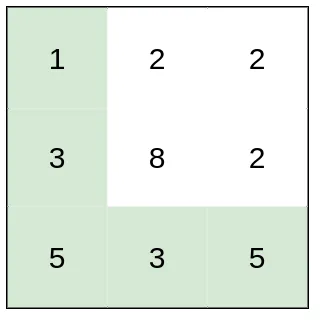
Input: heights = [[1,2,2],[3,8,2],[5,3,5]]Output: 2Explanation: The route of [1,3,5,3,5] has a maximum absolute difference of 2 in consecutive cells.This is better than the route of [1,2,2,2,5], where the maximum absolute difference is 3.この問題が優秀な総合問題である理由は、少なくとも4つの異なるアルゴリズムパラダイムで解くことができ、それぞれの解法が異なる思考の角度を示しているからです。
| 手法 | 中心となる考え方 | 時間計算量 |
|---|---|---|
| 二分探索 + BFS/DFS | 最適化問題を判定問題に変換 | O(mn · log(maxHeight)) |
| Union-Find (Kruskal) | 問題を最小ボトルネック経路としてモデル化 | O(mn · log(mn)) |
| Dijkstra | 最短経路アルゴリズムを改造し、緩和条件を max に変更 | O(mn · log(mn)) |
重要な観察:この問題が求めているのは、経路上の全辺の重みの和の最小値(古典的な最短経路)ではなく、経路上の単一の辺の重みの最大値の最小値です。このような “minimax path” 問題は、グラフ理論では最小ボトルネック経路 (Minimum Bottleneck Path) と呼ばれます。
最適化問題を判定問題に変換します。
- 判定問題:閾値
thresholdが与えられたとき、左上から右下までの経路であって、隣接セル間の高さの差がすべてthreshold以下となるものが存在するか? - 単調性:
threshold = kで実行可能なら、threshold = k+1でも必ず実行可能です。この単調性が二分探索の正当性を保証します。 - 探索空間:答えは
[0, maxHeight - minHeight]の範囲にあります。この区間で二分探索を行い、毎回 BFS/DFS で実行可能性を検証します。
class Solution {private:    int m, n;    int dir[4][2] = { {0, 1}, {0, -1}, {1, 0}, {-1, 0} };
public:    int minimumEffortPath(vector<vector<int>>& heights) {        m = heights.size();        n = m > 0 ? heights[0].size() : 0;        int left = 0, right = 10e6;        int res = -1;        while (left <= right) {            int mid = left + (right - left) / 2;            bool reachable = bfs(heights, mid);            if (reachable) {                res = mid;                right = mid - 1;            }else {                left = mid + 1;            }        }        return left;    }
    bool bfs(vector<vector<int>> &heights, int limit) {        queue<pair<int, int>> q;        q.push({0, 0});        vector<vector<bool>> vis(m, vector<bool>(n, false));        vis[0][0] = true;        while (!q.empty()) {            int x = q.front().first, y = q.front().second;            q.pop();            if (x == m - 1 && y == n - 1) {                return true;            }            for (int i = 0; i < 4; i++) {                int new_x = x + dir[i][0];                int new_y = y + dir[i][1];                if (new_x >= 0 && new_y >= 0 && new_x < m && new_y < n && !vis[new_x][new_y] && abs(heights[new_x][new_y] - heights[x][y]) <= limit) {                    q.push({new_x, new_y});                    vis[new_x][new_y] = true;                }            }        }        return false;    }
}class Solution {private: int m, n; int dir[4][2] = { {0, 1}, {0, -1}, {1, 0}, {-1, 0} };
public: int minimumEffortPath(vector<vector<int>>& heights) { m = heights.size(); n = m > 0 ? heights[0].size() : 0; vector<vector<bool>> vis(m, vector<bool>(n, false)); int left = 0, right = 10e6; while (left < right) { int mid = left + (right - left) / 2; for (int i = 0; i < m; i++) { std::fill(vis[i].begin(), vis[i].end(), false); } dfs(heights, 0, 0, mid, vis); if (vis[m - 1][n - 1]) { right = mid; }else { left = mid + 1; } } return left; }
void dfs(vector<vector<int>> &heights, int x, int y, int threshold, vector<vector<bool>> &vis) { if (x < 0 || y < 0 || x >= m || y >= n || vis[x][y]) { return; } vis[x][y] = true; for (int i = 0; i < 4; i++) { int new_x = x + dir[i][0]; int new_y = y + dir[i][1]; if (new_x < 0 || new_y < 0 || new_x >= m || new_y >= n || vis[new_x][new_y]) { continue; } if (abs(heights[new_x][new_y] - heights[x][y]) > threshold) { continue; } dfs(heights, new_x, new_y, threshold, vis); } }};別の角度から考えます。グリッドをグラフと見なし、隣接するセルのペアごとに辺を張り、辺の重みを高さの差の絶対値とします。
問題は次のように変換されます:このグラフ上で (0,0) から (m-1,n-1) への経路のうち、経路上の最大辺重みが最小となるものを見つける。
Kruskal の思想:すべての辺を重みの昇順にソートし、順に Union-Find に追加していきます。スタートとゴールが初めて連結されたとき、最後に追加した辺の重みが答えとなります。
なぜ正しいのか?重みが現在の辺以下の辺のみを追加した時点でスタートとゴールが連結されたということは、最大辺重みが現在の辺重みと等しい経路が存在し、かつそれより小さくすることは不可能(そうでなければ既に連結されていたはず)だからです。
class UnionFind {private:    vector<int> pa;    int count;public:    UnionFind(int n):pa(n), count(n) {        for (int i = 0; i < n; i++) {            pa[i] = i;        }    }    int root(int x) {        return x == pa[x] ? x : pa[x] = root(pa[x]);    }    void uni(int x, int y) {        int px = root(x);        int py = root(y);        if (px != py) {            pa[px] = py;            count--;        }    }    bool connected(int x, int y) {        return root(x) == root(y);    }};
struct Edge {    int x, y;    int d;    Edge(int _x, int _y, int _d): x(_x), y(_y), d(_d) {};    bool operator < (const Edge &other) const {        return d > other.d;    }};
class Solution {public: int minimumEffortPath(vector<vector<int>>& heights) { int m = heights.size(); int n = heights[0].size(); priority_queue<Edge> edges; for (int i = 0; i < m; i++) { for (int j = 0; j < n; j++) { int id = i * n + j; if (i > 0) { edges.push(Edge(id - n, id, abs(heights[i][j] - heights[i - 1][j]))); } if (j > 0) { edges.push(Edge(id - 1, id, abs(heights[i][j] - heights[i][j - 1]))); } } } UnionFind uf(m * n); int res = 0; while (!edges.empty()) { Edge e = edges.top(); edges.pop(); uf.uni(e.x, e.y); if (uf.connected(0, m * n - 1)) { res = e.d; break; } } return res; }};古典的な Dijkstra は経路の辺重みの和の最小値を求めるもので、緩和条件は次の通りです。
dist[v] = min(dist[v], dist[u] + w(u,v))この問題では緩和条件を次のように変更するだけです。
dist[v] = min(dist[v], max(dist[u], w(u,v)))つまり、v に到達するための「距離」を経路上の最大辺重みと定義します。この変形でも Dijkstra の貪欲性は成立します。優先度付きキューから取り出されたノードの dist 値は必ず最適です。なぜなら、後から取り出されるノードはより大きな辺を経由することになるからです。
struct Node {    int x, y;    int limit;    Node(int _x, int _y, int _limit) : x(_x), y(_y), limit(_limit) {}    bool operator < (const Node &other) const {        return limit > other.limit;    }};
class Solution {private:    int dirs[4][2] = { {0, 1}, {0, -1}, {1, 0}, {-1, 0} };
public:    int minimumEffortPath(vector<vector<int>>& heights) {        int m = heights.size(), n = m > 0 ? heights[0].size() : 0;        vector<vector<bool>> vis(m, vector<bool>(n, false));        priority_queue<Node> pq;        pq.emplace(Node(0, 0, 0));        vector<int> dist(m * n, INT_MAX);        dist[0] = 0;        while (!pq.empty()) {            Node node = pq.top();            pq.pop();            int x = node.x, y = node.y, limit = node.limit;            if (vis[x][y]) {                continue;            }            if (x == m - 1 && y == n - 1) {                break;            }            vis[x][y] = true;            for (int i = 0; i < 4; i++) {                int nx = x + dirs[i][0];                int ny = y + dirs[i][1];                if (nx < 0 || ny < 0 || nx >= m || ny >= n) {                    continue;                }                int new_limit = max(limit, abs(heights[nx][ny] - heights[x][y]));                if (new_limit >= dist[nx * n + ny]) {                    continue;                }                dist[nx * n + ny] = new_limit;                pq.emplace(Node(nx, ny, new_limit));
} } return dist.back(); }};3つの手法は本質的に同じ問題を異なる視点から解いています。
- 二分探索 + BFS/DFS:答えを推測し、実行可能性を検証する。答えに単調性がある場合に適用可能。
- Union-Find:小さい辺から順に追加し、いつ連結するかを観察する。ボトルネック経路問題に適している。
- Dijkstra:貪欲に拡張し、毎回現在の最小コストの経路を選ぶ。改造後も貪欲性が成立する最短経路の変種に適用可能。
この「経路上の最大辺重みを最小化する」タイプの問題は、LeetCode や競技プログラミングで繰り返し登場します。
| 問題 | 核心となる違い |
|---|---|
| 778. Swim in Rising Water | 辺重みが max(grid[nx][ny], grid[x][y]) になる。水位がセルの高さまで下がるのを待つ必要がある |
| 1102. Path With Maximum Minimum Value | 逆問題:経路上の最小値を最大化する (maximin)。同じ3つの手法が使える |
| 2812. Find the Safest Path in a Grid | まず BFS で各セルから最も近い脅威までの距離を前計算し、その後 maximin path を求める |
| 1514. Path with Maximum Probability | 辺重みが確率で、経路値は積の最大値。Dijkstra で max を取る変種 |
「二分探索 + BFS/DFS 検証」は汎用的なアルゴリズム設計パラダイムであり、以下の条件を満たす問題に適用できます。
- 答えが順序付けられた区間内にある
- 答えに単調性がある(実行可能/不可能の境界点が存在する)
- 答えが与えられると、判定問題が元の問題よりはるかに簡単になる
よくある応用例: